Stewart Copeland Tests The Police at Orchestral Scale
At Miner Auditorium, the former Police drummer revisited a catalog built on tension and speed, asking how much bite remains in a full orchestra.
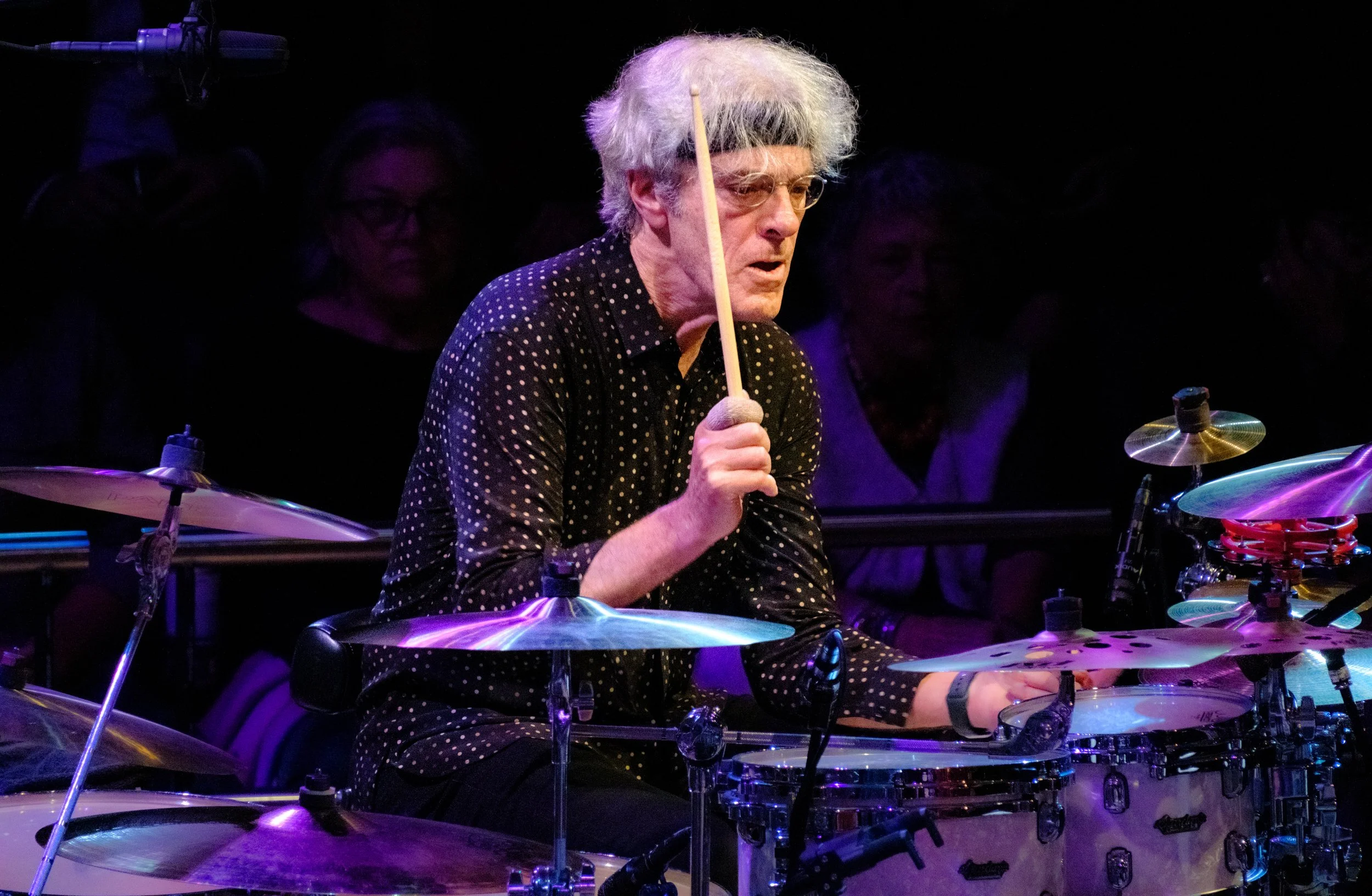
Stewart Copeland at Miner Auditorium. Photo: Steve Roby
Last Friday at Miner Auditorium, Stewart Copeland brought his long-running orchestral reworking of the Police songbook, Deranged for Orchestra, to San Francisco with the San Francisco Conservatory of Music Orchestra (SFCM). As the rhythmic architect of the Police, he helped shape a band whose fusion of punk velocity and reggae elasticity propelled it from clubs to worldwide prominence, culminating in Synchronicity and the 1983 Shea Stadium finale.
That music has never stopped circulating, and it still reaches younger listeners because its clipped phrasing, sprung rhythms, and wary emotional temperature belong to no single era. The question behind this project is simple enough: when songs built on nerve, tension, and air are expanded to a symphonic scale, do they still draw blood?
Copeland treats The Police’s catalog as material to be cut open and rearranged. Working from the original multitracks, he extracts vocal fragments, rhythmic patterns, and harmonic details, then redistributes them across the orchestra. Since the project’s 2021 debut, the compositions have grown more settled and more precise, shaped by repeated performances with different ensembles. The arrangements show how much structural strength these songs can withstand even after their parts have been reassigned, while keeping the evening’s larger question in view: what happens when music defined by concision and attack is asked to occupy more space?
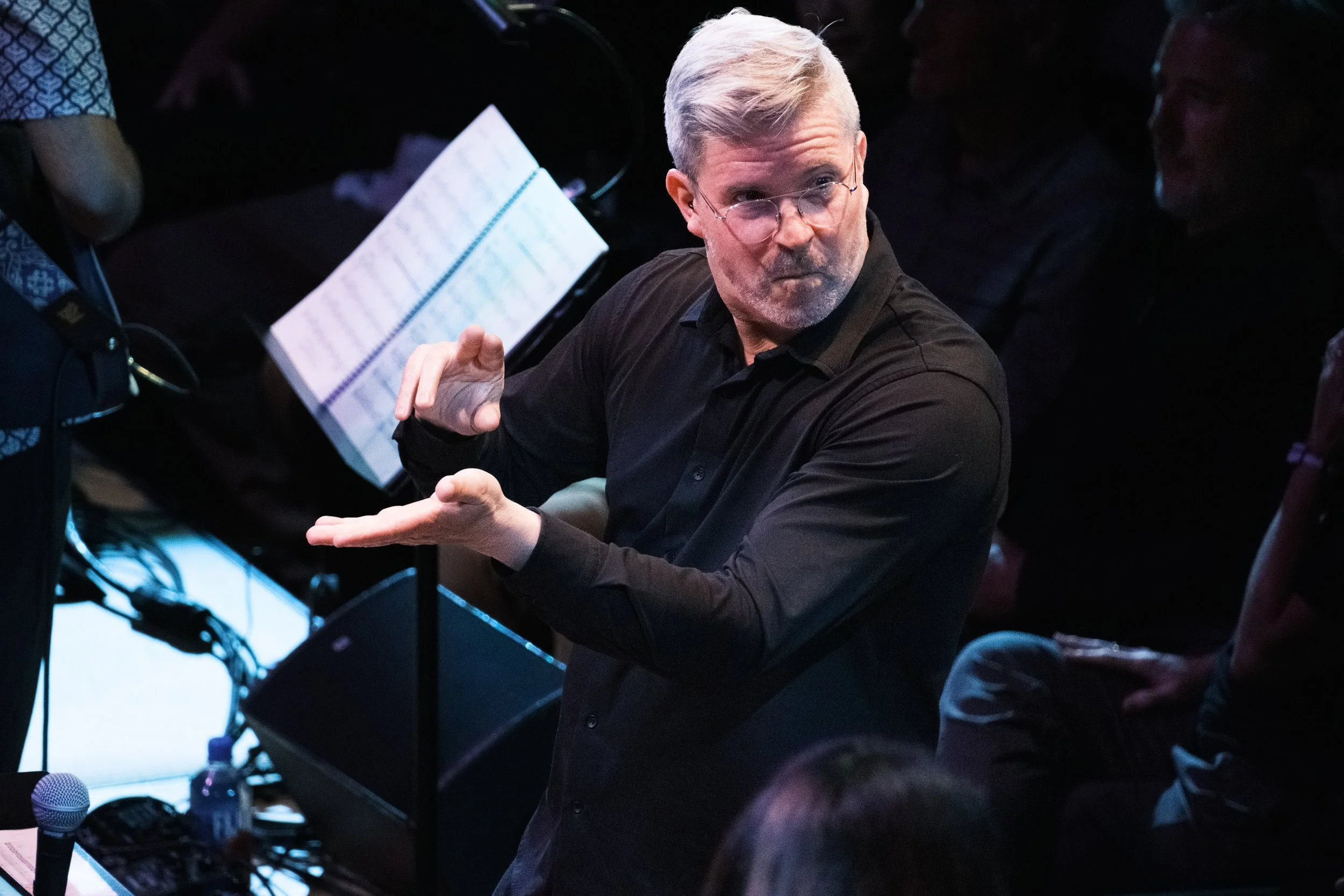
Conductor Edwin Outwater. Photo: Steve Roby
Miner Auditorium, typically scaled for small ensembles, required expansion with a wall-to-wall stage to accommodate the 22-piece SFCM, including harp, gran cassa, and an expanded rhythm section. Winds, brass, and strings occupied stage right, while bass, guitar, percussion, and Copeland’s drum kit anchored stage left. Conductor Edwin Outwater led the ensemble with clear focus, maintaining coordination across a dense, often shifting score.
But there is a fundamental cost to this expansion. The Police’s sonic identity was built on volume, velocity, and immediate physical force. Their arrangements were clipped because they needed to cut—to project in clubs and arenas without amplification beyond basic PA support. Orchestrate them, and you trade that punch for breadth, immediacy for architecture. On Friday, that trade-off registered clearly in the room.
The problem was immediate. Armand Sabal-Lecco’s electric bass and Amithav Gautam’s guitar—the instruments that carry the groove in the original recordings—couldn’t project with presence over the orchestral strings and brass. The overall sound settled into a moderate dynamic range, closer to chamber restraint than arena force. This wasn’t a mixing error or a balance miscalculation. It was the inevitable result of asking electric instruments scaled for rock venues to compete with an orchestra. The Police songs need electricity to breathe. Without it, they become something else entirely: sophisticated, architecturally interesting, but fundamentally diminished in the ways that made them matter.
Copeland's stage presence provided a counterweight to that restraint, with no apparent effect of his 73 years and long musical career. Between pieces, he moved easily between gestural anecdotes and entertaining explanations for the audience, recalling Bay Area memories and tracing the project's origins—from home movies to a film score to an orchestral adaptation. His account of "deranging" the songs offered a working method: cut into the material, surface overlooked fragments, and rebuild from there. That generosity—opening the arrangements to an ensemble of young musicians and inviting them into the thinking—was genuinely admirable.
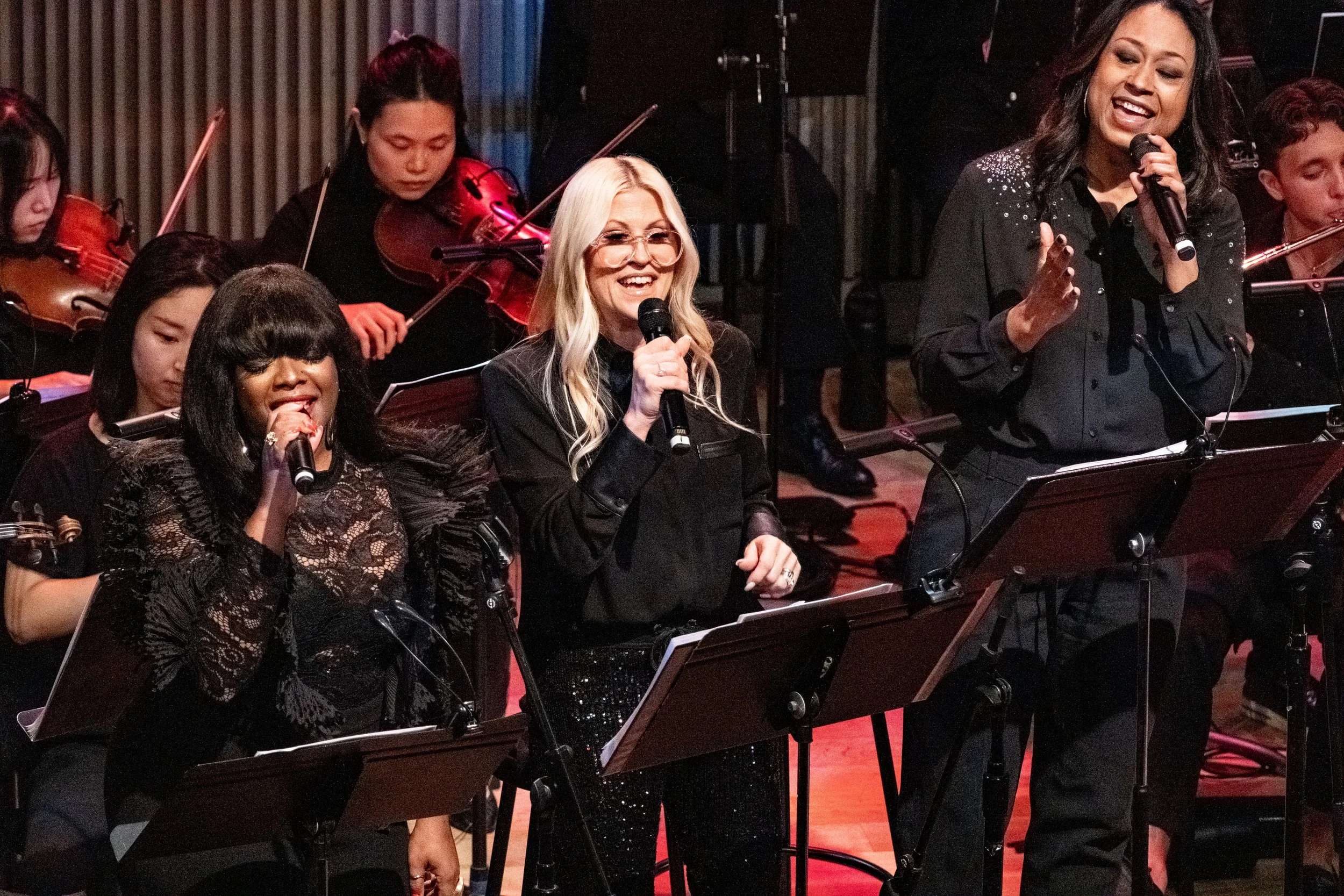
The Dazzling Derangettes. Photo: Steve Roby
The vocal trio, sometimes known as The Dazzling Derangettes—Christine Miller, Carmel Gaddis, Ashley Tamar—brought a different kind of continuity. Their phrasing and tonal control carried elements of the original recordings into the orchestral setting, at times restoring a sense of immediacy that the larger ensemble had diffused. In the latter portion of the program, Copeland ceded the drum chair to Tania Cosma, a Conservatory student, and took up conducting with a single drumstick. Cosma’s playing was direct and assured, grounding performances of “Every Breath You Take” and “The Bed’s Too Big Without You” with steady focus.
The SFCM students brought focused attention to their parts. The Conservatory musicians played with clarity and discipline, and several arrangements revealed genuine compositional detail that the original recordings bury. "Murder by Numbers," in particular, emerged with its harmonic quirks foregrounded in ways the sparse original couldn't quite articulate. "Roxanne," heavily reworked, took on a new shape. These were legitimate artistic discoveries.
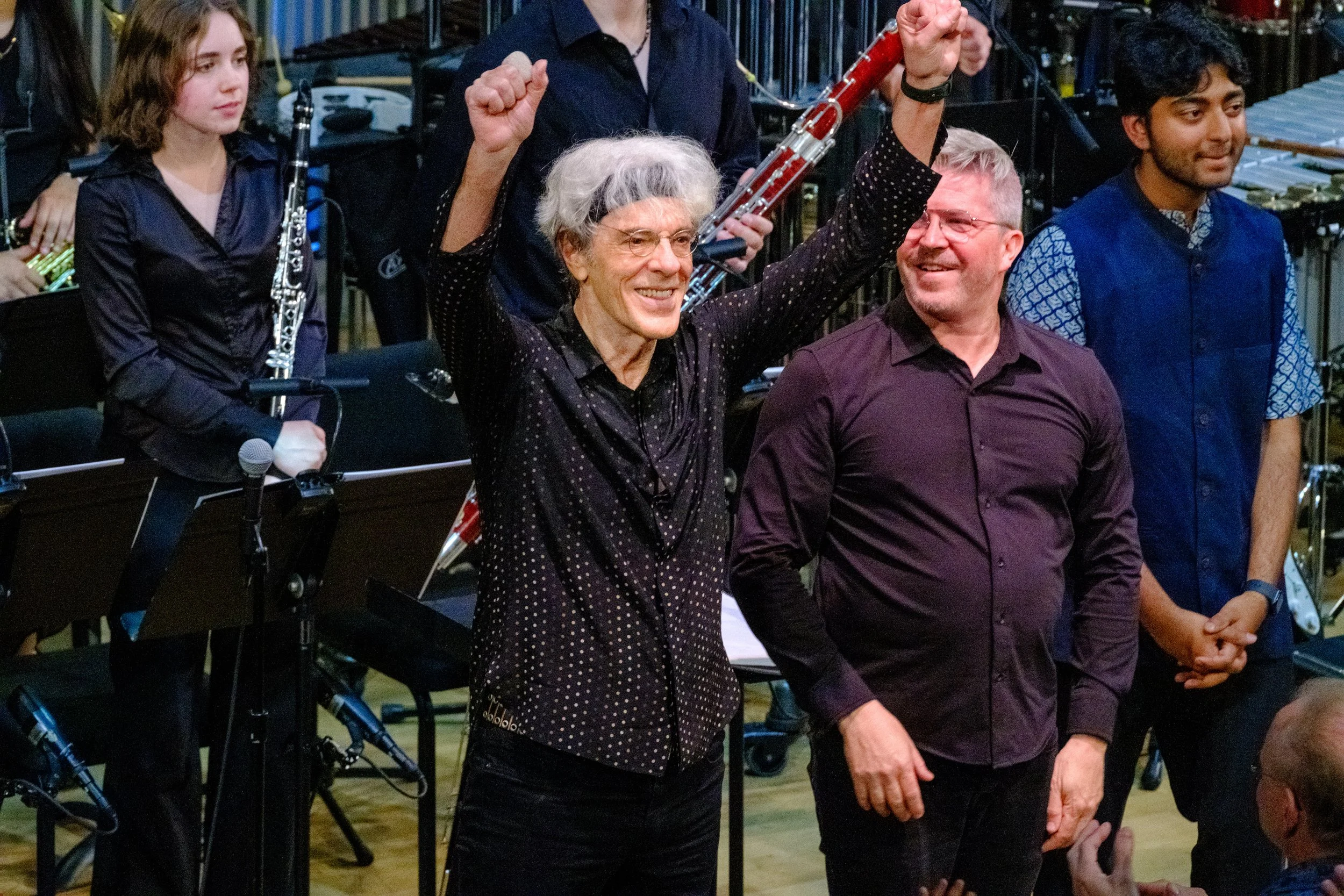
Stewart Copeland and the SFCM Orchestra. Photo: Steve Roby
In the latter portion of the program, Copeland ceded the drum chair to Tania Cosma, a Conservatory student, and took up conducting with a single drumstick. Cosma's playing was direct and assured, grounding performances of "Every Breath You Take" and "The Bed's Too Big Without You" with steady focus. It was a genuine pedagogical gesture—not a gimmick, but an invitation into the space itself.
The evening closed without resolving its central question. Copeland’s project is intellectually honest about its trade-off: expand the arrangements, and you gain precision and compositional depth. But you lose the qualities that made the original music necessary: the velocity, the bite, the sense that something urgent is happening in the room. This isn’t a failure of execution or ambition. It is the unavoidable consequence of the premise itself. You cannot orchestrate The Police into an arena-sized force. You can only demonstrate—with skill and genuine pedagogical warmth—what they become when you try.
Copeland returns to San Francisco in June for his Have I Said Too Much? The Police, Hollywood, and Other Adventures spoken-word tour, featuring photos, videos, and a Q&A on his incredible life as a performer.
Program Notes
Event: Police Deranged for Orchestra
Artists: Stewart Copland w/ San Francisco Conservatory of Music Orchestra conducted by Edwin Outwater
Date: Friday, April 10, 2026
Showtime: 7:30 p.m.
Venue: Miner Auditorium (SFJAZZ Center)
Location: San Francisco
Personnel
Stewart Copeland: drums, guitar, conductor
Edwin Outwater: conductor
Armand Sabal-Lecco: bass
The Dazzling Derangettes: Christine Miller, Carmel Gaddis, Ashley Tamar
SFCM Members
Violin I
Aleksi Zaretsky
Ruby Ro
Rachel Green
Violin 2
Jaimie Yoon
Zeke Sokoloff
Harry Wang
Viola
Seyeon Park
Julia Chen
Erika Cho
Cello
Elmer Carter
Calvin Kung
Eric Inadomi
Winds/Brass/Percussion
Flute: Beneditto Caroccio
Oboe: Nicholas Karr
Clarinet: Zoe King
Bassoon: Justice Gardner
Alto Sax: Kira Agrell
Tenor Sax: Trent Horio
Bari Sax: Xitlalli Estrella
Trumpet: 1 Jordan Ku
Trumpet 2: Marcus Chu
Trombone: Vidyuth Guruvayurappan
Bass Trombone: Jacob Ellgass
Percussion I/Drumset: Tania Cosma
Percussion II: Sean Edwards
Percussion III: Will Morgan
Keyboard: Xinyu Jiang
Guitar: Amithav Gautam
Harp: Julia Grunbaum
Drums: Tania Cosma
Setlist: “Demolition Man,” “King of Pain,” “Roxanne,” “Murder By Numbers,” “Spirits in the Material World,” “One World (Not Three),” “Waking On The Moon,” “The Equalizer Busy Equalizing,” “Every Breath You Take,” “Orc Jam” “The Bed’s Too Big Without You,” “Don’t Stand So Close To Me,” “Message In A Bottle,” “I Can’t’ Stand Losing You/Reggatta de Blanc”
Encore: “Every Little Thing She Does Is Magic”
*Note: On 04/11/26, the singers were Amy Keys, Carmel Gaddis, and Ashley Tamar.
Listen to our 2025 interview with Andy Summers.
Read our review of Andy Summers at the Presidio.
Share the full article with the links below.